
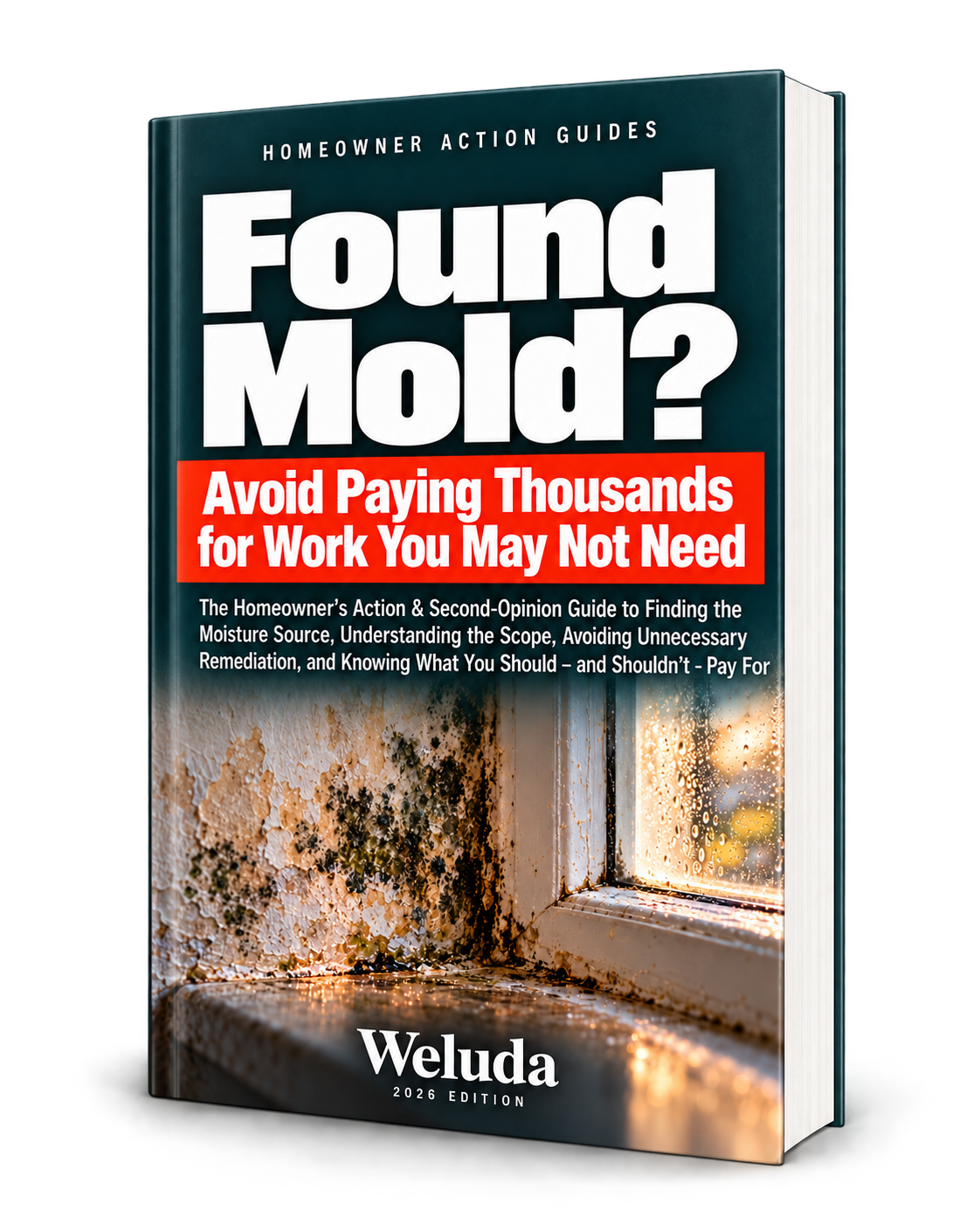
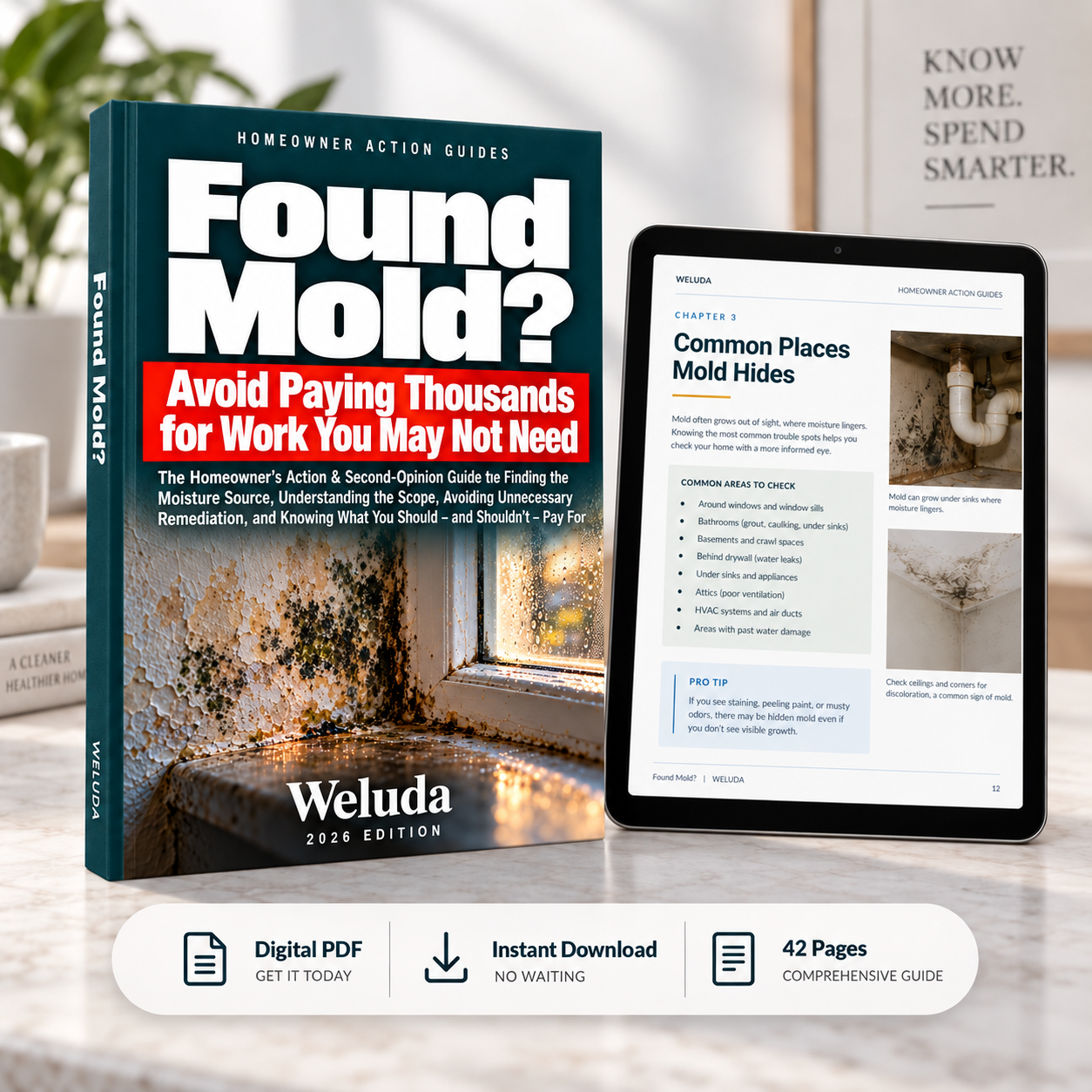
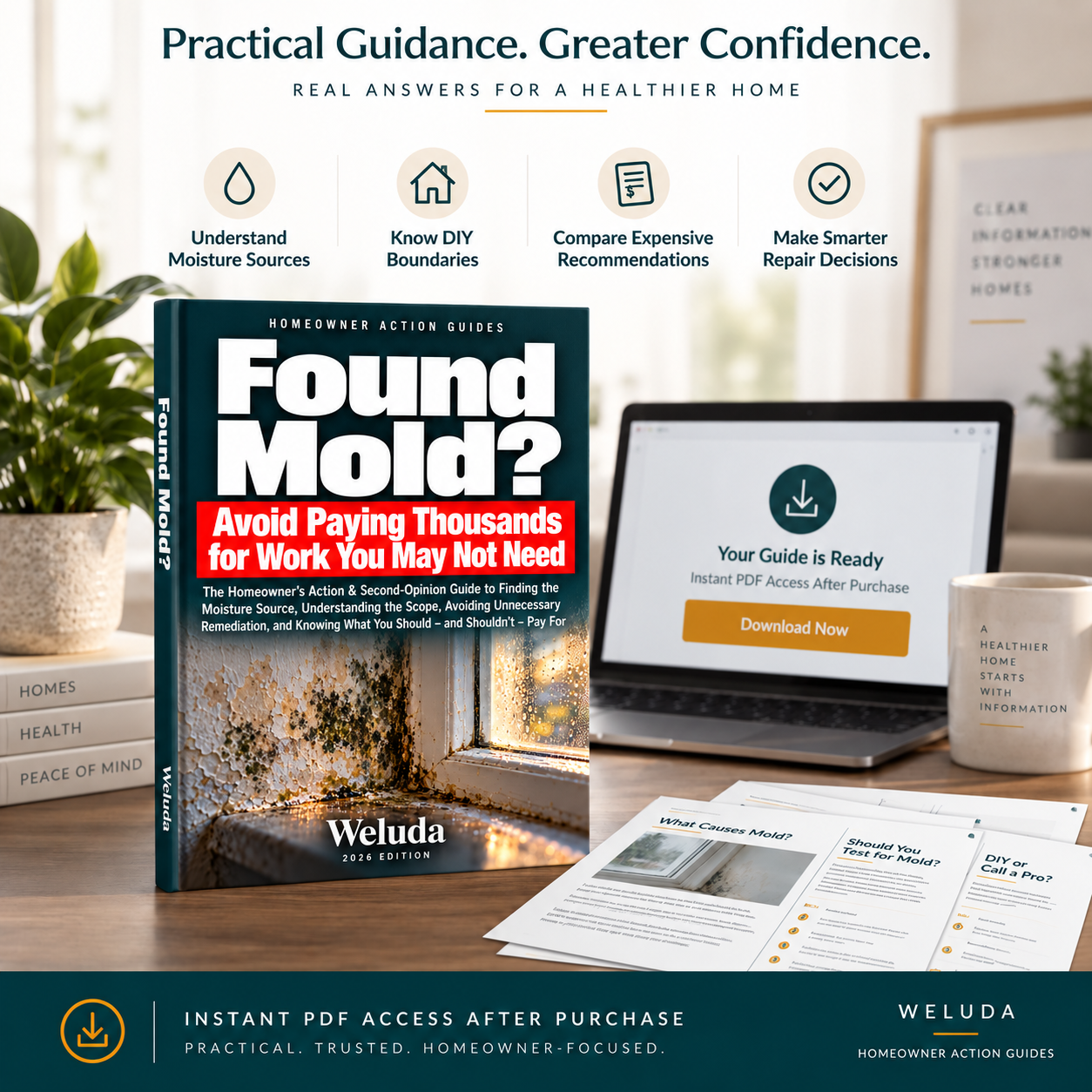
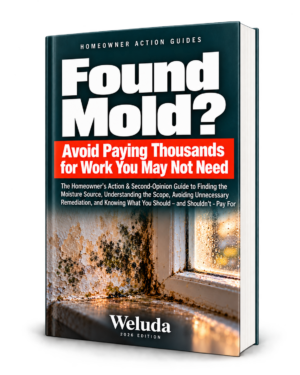
Found Mold?
Original price was: $49.00.$29.00Current price is: $29.00.
Before you spend hundreds or thousands on mold testing, remediation, demolition, HVAC work, cleanup, or repairs, understand what the problem actually requires.
A practical Homeowner Action & Second-Opinion Guide to help you identify useful evidence, trace moisture sources, understand DIY limits, compare professional recommendations, evaluate costs, and verify the result.
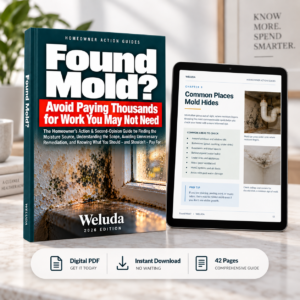
Digital PDF · 42 pages · 5 printable worksheets · Instant download after payment
Description
Understand the Problem Before You Pay for the Solution
Finding visible mold, noticing a musty odor, or discovering repeated moisture can quickly turn into an expensive decision.
A mold professional may recommend remediation. Another provider may recommend testing. Someone else may suggest demolition, HVAC work, leak repair, reconstruction, or additional treatment.
Some of that work may be completely justified.
The important question is:
What does the evidence in your home actually support?
Found Mold? is a practical Homeowner Action & Second-Opinion Guide designed to help you understand the problem before approving expensive work.
It does not try to turn you into a mold-remediation professional. Instead, it helps you make a better-informed next decision.
What This Guide Helps You Do
- Recognize useful mold and moisture clues
- Document visible growth, stains, odors, and damp areas
- Separate observations from assumptions
- Trace common moisture sources such as leaks, condensation, humidity, and water intrusion
- Inspect accessible areas more safely
- Understand when limited DIY may be reasonable
- Know when DIY should stop
- Understand why mold color does not determine severity
- Know when mold testing may be useful
- Understand when testing may not change the decision
- Identify common moisture and condensation problems
- Understand when HVAC involvement changes the scope
- Evaluate mold inspection, remediation, cleanup, and repair costs
- Compare contractor recommendations
- Separate remediation from moisture-source repair and reconstruction
- Identify optional work versus work tied directly to the documented problem
- Verify drying and cleanup before rebuilding
- Reduce the chance of recurrence
Before You Approve Expensive Work
One of the most useful questions in the guide is:
“If I approve only the minimum work necessary to correct the moisture source, remove or clean the affected materials, and verify the result — what exactly is that scope, and what evidence supports each line item?”
A small visible patch does not automatically justify broad demolition.
A musty odor does not automatically mean the entire home requires remediation.
Dark-colored growth does not automatically establish that a condition is more dangerous.
A mold test does not automatically determine the correct scope of work.
The guide helps you separate the confirmed problem from assumptions and optional improvements before you approve a larger scope of work.
Understand Typical Costs
The guide includes U.S. planning ranges for common mold-related services and explains why quotes can vary.
You will learn how to separate:
- Professional inspection
- Sampling and testing
- Smaller remediation projects
- Mid-scope remediation
- Large or complex remediation
- Moisture-source repair
- HVAC-related work
- Reconstruction
- Optional services
This makes it easier to compare proposals intelligently instead of comparing two totals that may include completely different scopes.
Understand When Mold Testing Is Useful
Visible mold does not always require broad testing before action can be taken.
The guide explains when testing may be useful, including situations involving disputed hidden growth, formal remediation protocols, transactions, insurance questions, or post-remediation verification.
It also explains why testing should answer a defined question and change a decision — rather than simply produce numbers without a clear purpose.
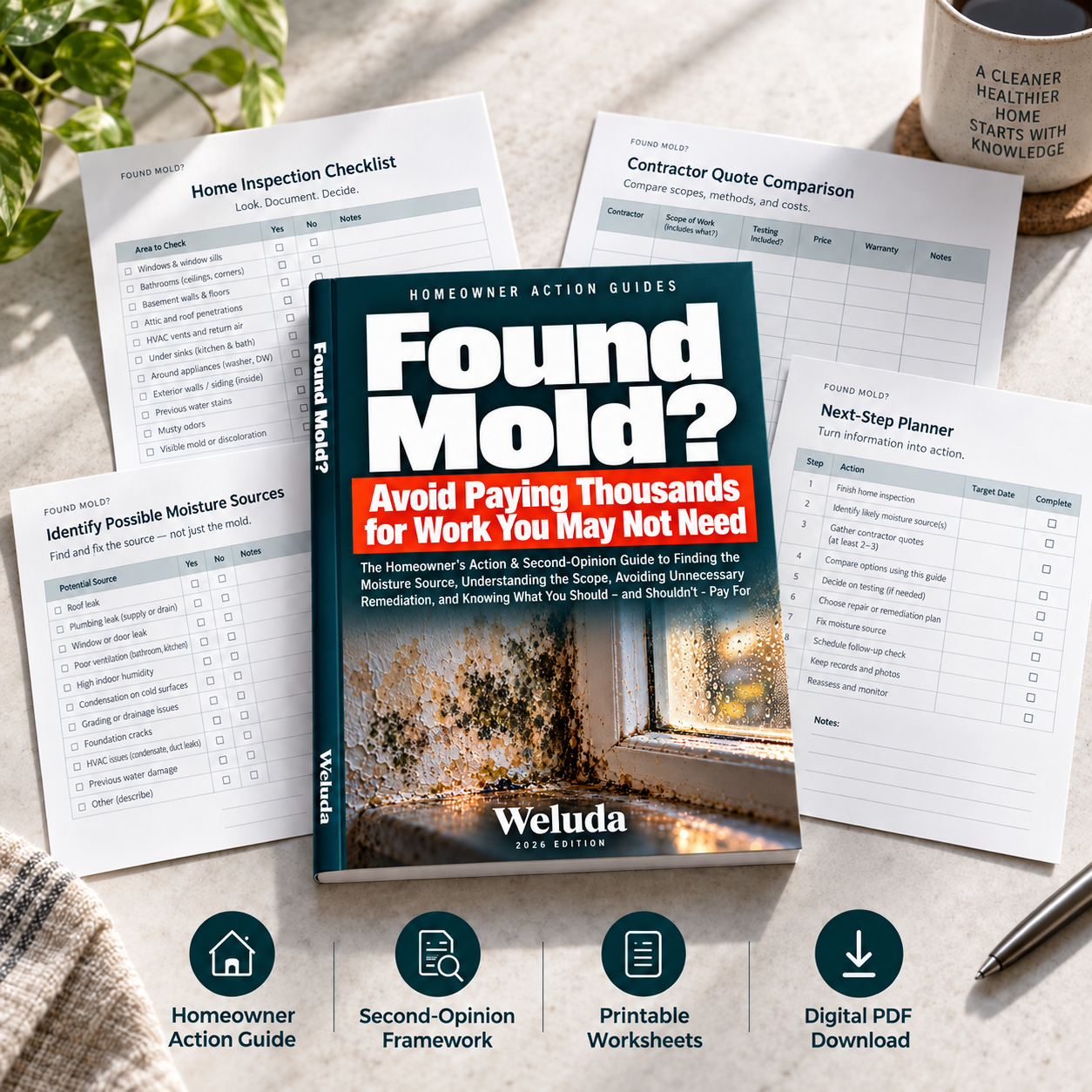
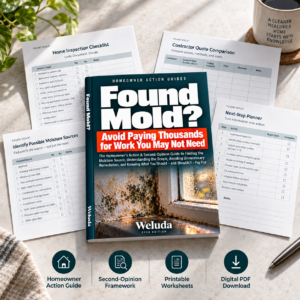
Five Printable Worksheets Included
- Quick Action Sheet
- Home Inspection Checklist
- Contractor Quote Comparison
- Product & Material Checklist
- 30-Day Prevention Checklist
These worksheets are designed to help you organize evidence, moisture observations, contractor recommendations, purchases, and follow-up decisions.
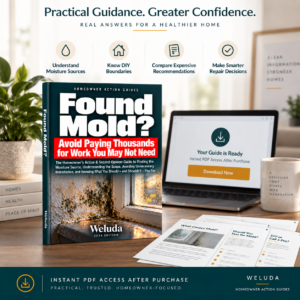
Digital PDF — Instant Access After Purchase
This product is a digital PDF, not a physical book.
After your payment is successfully completed, your download link will be made available through your order and/or the email address used during checkout.
You can save the PDF to your computer, tablet, or phone and print the worksheets for your own household use.
No physical product will be shipped.
Important Safety Note
This guide provides practical educational information for homeowners.
It does not diagnose illness, certify a building, identify mold species or toxicity from appearance, or replace qualified mold-remediation, indoor environmental, HVAC, plumbing, roofing, structural, electrical, medical, or other professionals.
The guide identifies situations where household work should stop and professional help should be used.
Digital Product Refund Policy
Because this is an immediately accessible digital product, purchases are generally non-refundable once the download has been made available, except where required by applicable law.
If you experience a technical problem accessing the file, receive a defective file, or are charged more than once for the same purchase, please contact us so we can resolve the issue.
Frequently Asked Questions
What is Found Mold??
Found Mold? is a 42-page digital homeowner action and second-opinion guide from Weluda.
It helps homeowners understand mold and moisture evidence, inspect accessible areas more safely, evaluate limited DIY options, compare professional recommendations, understand costs, and verify results.
Is this a mold-removal or remediation service?
No. This is a downloadable educational PDF guide.
It does not include mold inspection, testing, remediation, or repair services and does not replace a qualified professional.
Can this guide help me decide whether I need professional mold remediation?
Yes. The guide includes practical response lanes and boundaries designed to help homeowners distinguish between limited household action, further investigation, and situations that warrant professional help.
Does the guide explain mold inspection and remediation costs?
Yes. It includes broad U.S. planning ranges for professional inspection, testing, smaller remediation projects, mid-scope remediation, and larger or more complex work.
Does it explain how to find the moisture source?
Yes. The guide explains common moisture pathways including plumbing leaks, roof or exterior intrusion, condensation, indoor humidity, HVAC condensate problems, and past wetting that never fully dried.
Does it explain mold testing?
Yes. The guide explains when testing may provide useful decision value and when the result may not change the appropriate next step.
Can this guide help me compare contractor quotes?
Yes. The guide includes a contractor quote comparison worksheet and explains how to separate remediation, moisture-source repair, reconstruction, testing, and optional services.
Does the guide identify whether black mold is toxic?
No. Color alone cannot reliably determine mold species, toxicity, airborne concentration, or health risk.
The guide focuses on moisture source, affected material, extent, location, exposure, and appropriate next steps.
What format will I receive?
You will receive a digital PDF download after your purchase is successfully completed.
No physical product is shipped.
Can I print the guide?
Yes. You may print a copy for your own household use, including the five worksheets included at the end of the guide.
Can I get a refund after downloading the PDF?
Because this is an immediately delivered digital product, purchases are generally final once access has been provided, except where required by applicable law or where there is a technical or billing problem.
Does this guide guarantee that I can solve the mold problem myself?
No. The guide is designed to help you understand the problem, recognize reasonable DIY boundaries, and make a better-informed next decision.
Some situations require professional inspection, remediation, HVAC work, moisture-source repair, reconstruction, or other qualified services.
A Practical Second Opinion Before an Expensive Decision
The goal of Weluda is simple:
Understand the problem. Choose the next step. Spend smarter.
Reviews (0)
Only logged in customers who have purchased this product may leave a review.
Related products

Reviews
There are no reviews yet.